Most cities bury their history. Kathmandu just keeps living inside it.
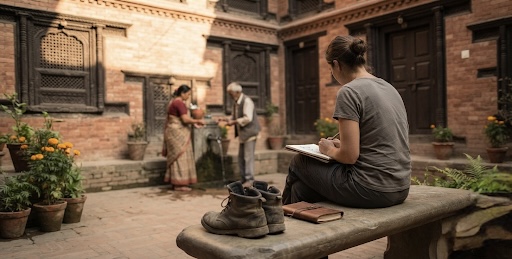
Walk through the old city on any ordinary morning and you’ll pass a thousand-year-old shrine the way locals pass a corner shop, without a second glance, because it’s simply part of the walk to work. That’s the thing outsiders rarely expect about Kathmandu’s temples: they were never built to be museums. They’re still in use, still catching incense smoke every morning, still hosting the same small rituals they were built for, centuries before anyone thought to call them tourist sites.
Swayambhunath, the Hill That Belongs to Two Faiths
Swayambhunath sits on a hilltop above the city, its white stupa visible from long before you reach it, painted eyes watching in every direction. What makes it unusual isn’t just its age, it’s that both Hindus and Buddhists consider it sacred, a rare piece of shared ground in a region where religious lines are usually drawn firmly. Climb the stone steps at sunrise, before the crowds arrive, and the city below is still half-asleep, wrapped in a haze that the temple’s prayer flags cut straight through.
Boudhanath, Where the Circuit Never Stops
A short drive away, Boudhanath is one of the largest stupas in the world, and it functions less like a monument and more like a heartbeat for the city’s Tibetan Buddhist community. Pilgrims walk clockwise around its base in an endless, unhurried circuit, spinning prayer wheels as they go, some pausing for a full prostration, others simply walking and talking with a friend. Nobody performs this for visitors. It happens whether anyone is watching or not, which is exactly why it’s worth watching.
The Square That Still Has a Living Goddess
In the old royal quarter, Kathmandu Durbar Square holds the kind of detail that’s easy to miss if you’re rushing between photo stops. The Kumari Ghar, a carved wooden building just off the square, is home to the Kumari, a young girl worshipped as a living goddess during her years in the role. Nearby, Kasthamandap, one of the city’s oldest structures, is said to have given the whole Kathmandu Valley its name. None of this is roped off behind glass. It’s just there, load-bearing history holding up an ordinary Tuesday.
Why This Still Matters
There’s a specific kind of quiet that settles into a place this old, not silence exactly, since there’s always a bell ringing somewhere or a vendor calling out, but a sense that whatever is happening around you has happened ten thousand mornings before this one, and will happen ten thousand more after you’ve gone home. Nexus’s Kathmandu excursions are built around that feeling deliberately, not rushing past the temples on a checklist, but giving a traveler enough time to actually notice what the stone has been holding onto.
You don’t need to believe in any particular deity to feel something shift by the time you leave. That’s rarely the point of visiting these places anyway. The point is standing somewhere that thousands of strangers have stood before you, feeling something similar, and letting that be enough.